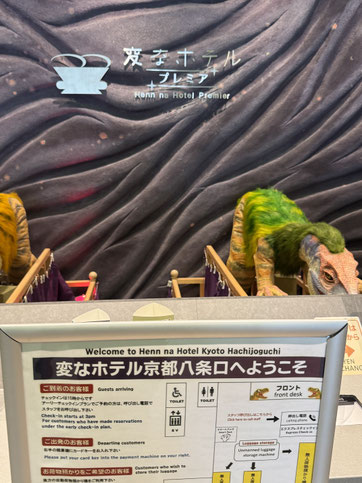
A dinosaur receptionist in Kyoto unexpectedly changed how I think about innovation, technology adoption, and customer experience.
Checking into a hotel in Kyoto staffed by dinosaur receptionists was not how I expected to begin my trip to Japan.
At first glance, it felt almost absurd.
A fun gimmick?
Perhaps.
But after spending time in Japan, I started wondering whether this playful interaction with technology points to something much deeper and surprisingly relevant to how societies adopt innovation.
Interestingly, concepts like Henn na Hotel were not entirely new to me. During hospitality trend discussions in Germany, particularly AI-focused conversations about the future of hotels, the dinosaur-staffed hotel had already surfaced as an example of experimental service design.
Experiencing it firsthand in Kyoto, however, shifted my perspective. Perhaps the real innovation was not the novelty itself.
Technology in Japan Feels Different
What struck me throughout Japan was how naturally technology seemed to coexist with everyday life.
From robots greeting guests to intelligent service systems in train stations and hospitality environments, technology often appeared less like something disruptive to fear and more like something to engage with.
It felt approachable.
Sometimes even playful.
And that distinction matters.
In many Western markets, discussions around emerging technologies such as artificial intelligence, automation, and robotics often begin with skepticism. We ask important questions:
- Which jobs will disappear?
- What risks might emerge?
- What should be regulated before adoption?
These concerns are legitimate.
But they can also unintentionally create psychological distance between people and innovation.
Technology becomes something abstract. Something potentially threatening. Something to resist before understanding.
Japan often appears to approach this relationship differently.
Rather than presenting technology purely as a tool for efficiency, there seems to be an intentional effort to make it understandable, accessible, and emotionally acceptable. Technology is not always framed as replacing people. In many cases, it complements human interaction, enhances convenience, or simply reduces friction in everyday experiences.
Innovation Adoption Is Not Just About Technology
This observation raises an important question:
What actually drives successful innovation adoption?
Many organizations focus heavily on technological capability. Better AI systems. Faster automation. More advanced digital infrastructure.
But innovation rarely succeeds through functionality alone.
Adoption depends on trust.
People are more likely to experiment with unfamiliar technologies when those technologies feel intuitive rather than intimidating. When systems feel approachable, curiosity tends to replace resistance.
This may be one reason why experimentation with technology in Japan often feels socially normalized.
Innovation, in that sense, becomes less of a technical challenge and more of a cultural one.
Because technological progress is not only about what can be built.
It is also about what people are willing to embrace.
What Businesses Can Learn from Japan’s Technology Culture
For leaders thinking about digital transformation, customer experience, or AI adoption, there may be an important lesson here.
Too often, innovation strategies focus exclusively on efficiency gains or technical implementation.
But adoption is emotional.
If people feel overwhelmed, skeptical, or disconnected from new systems, even the most advanced technology may struggle to create impact. Japan offers an interesting alternative perspective.
What if introducing technology also meant making it feel more human?
More understandable.
More inviting.
Perhaps organizations should think not only about whether a technology works, but also about how it feels to the people expected to interact with it. Especially in hospitality, service industries, and customer experience design, this question may become increasingly important.
The Competitive Advantage of Cultural Readiness
Of course, Japan faces many of the same challenges as other advanced economies, including demographic shifts, labor shortages, and the complexity of digital transformation.
But perhaps there is something worth learning from the country’s mindset toward technology.
A society that feels comfortable experimenting with innovation may ultimately integrate new technologies more effectively.
And that can become a real competitive advantage.
Maybe innovation is not only about building better technology.
Maybe it is also about making people feel comfortable enough to embrace it.
Sometimes, that process starts with something unexpectedly simple.
In my case, it started with a dinosaur checking me into a hotel.